Harmonica Tabs
Harmonica tab tells you which hole to play and whether to blow or draw: 4 means blow into hole 4, -4 means draw (breathe in) on hole 4, and apostrophes mean a bend. This page converts notes into tabs for a 10-hole diatonic harmonica in any key, shows every note on the harp including bends, and plays tabs back so you can hear if they are right.
- Free to use
- No sign-up
- Runs in your browser
Harmonica tab converter
Harmonica Charts and Tab Sheets
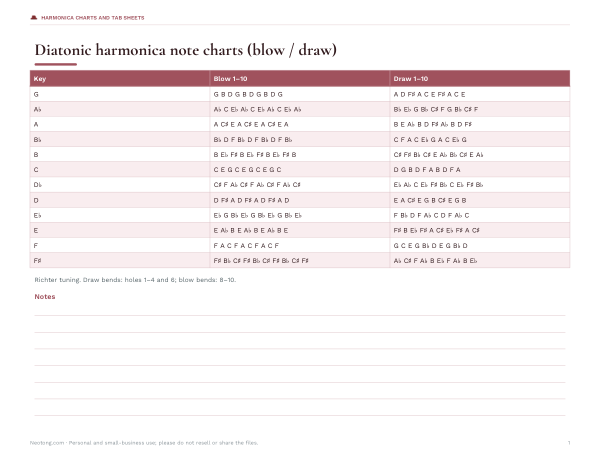
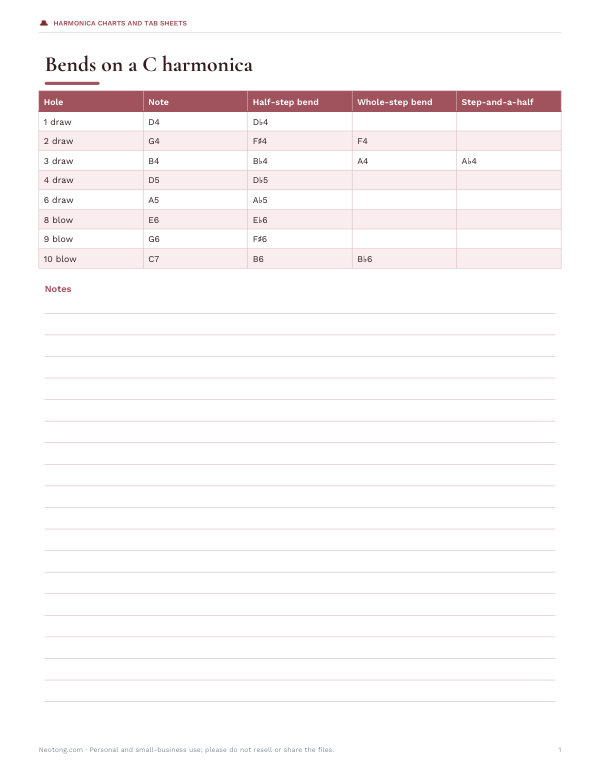
Printable 10-hole diatonic note charts for all twelve keys with bends, blank tab practice sheets and a harmonica practice log.
- 12-key charts (PDF/XLSX)
- Bending chart (PDF)
- Blank tab sheets (PDF)
- Practice log (PDF/DOCX/XLSX)
Formats: PDF, XLSX, DOCX. Instant download after payment (link valid 72 hours, up to 5 downloads). AI-assisted: the templates were drafted with AI help and reviewed and laid out before publishing.
$5.00 USD, one-time 4 files · about $1.25 each
- Instant download
- 7-day refund
- Secure checkout by Stripe
7-day money-back guarantee. Full refund within 7 days of purchase, even after you download.
Free sample: Bending Chart C (PDF, 71 KB)
Full refund within 7 days — see the refund policy and license.
Free printables
Single sheets you can print right now, no sign-up. The full pack adds every sheet in one download plus the editable files.
 Printable Harmonica Practice Log
How to read harmonica tab
| Tab | Meaning |
|---|---|
| 4 | Blow (breathe out) into hole 4 |
| -4 (or 4 with a down arrow, or 4D) | Draw (breathe in) on hole 4 |
| -3’ | Draw on hole 3 and bend down a half step |
| -3’’ | Draw on hole 3, bend down a whole step |
| 4 5 6 (stacked or in brackets) | Play the holes together as a chord |
| | | Bar line or phrase break |
Different books use slightly different symbols — some write draws as 4D or with a downward arrow, and some use a small b for bends — but the idea is always hole number plus blow or draw.
The 10-hole diatonic in C
| Hole | 1 | 2 | 3 | 4 | 5 | 6 | 7 | 8 | 9 | 10 |
|---|---|---|---|---|---|---|---|---|---|---|
| Blow | C4 | E4 | G4 | C5 | E5 | G5 | C6 | E6 | G6 | C7 |
| Draw | D4 | G4 | B4 | D5 | F5 | A5 | B5 | D6 | F6 | A6 |
This is standard (Richter) tuning. The middle octave, holes 4 to 7, has a complete major scale: 4 -4 5 -5 6 -6 -7 7 plays C D E F G A B C. Most simple melodies live here.
Harmonicas in other keys
A harmonica’s key is the note of its hole-1 blow chord. Harmonicas in other keys have the same layout shifted up or down: a G harmonica is lower than a C, a D harmonica higher. Tab stays the same for the same tune in the harp’s key — “Mary Had a Little Lamb” is 5 -4 4 -4 5 5 5 on any key of harmonica — which is why players pick the harmonica to match the song. Choose the key in the converter to see the notes each hole plays.
Bends
Bending lowers a note by changing the shape of your mouth and the airflow. On a standard diatonic you can bend draw notes on holes 1–4 and 6, and blow notes on holes 8–10. Hole 3 draw bends furthest — up to a step and a half — which is why it is so important in blues. The chart shows every standard bend for the key you choose. Bends take practice, so start with simple melodies that avoid them.
Using the converter
- Choose your harmonica’s key.
- In Notes → tabs, type note names separated by spaces (E D C D E…). Add octave numbers such as C6 if you need a specific octave.
- Read the tab; hover to see alternatives where a note can be played in two holes (for example G4 is -2 or 3).
- Switch to Tabs → notes to type tab and hear it, to check a tab you found.
- Press Play to hear the melody at your chosen tempo.
Public-domain songs to practise (C harmonica)
| Song | Tab |
|---|---|
| Mary Had a Little Lamb | 5 -4 4 -4 5 5 5 | -4 -4 -4 | 5 6 6 |
| Twinkle Twinkle Little Star | 4 4 6 6 -6 -6 6 | -5 -5 5 5 -4 -4 4 |
| Ode to Joy (Beethoven) | 5 5 -5 6 6 -5 5 -4 4 4 -4 5 5 -4 -4 |
| Oh When the Saints | 4 5 -5 6 | 4 5 -5 6 | 4 5 -5 6 5 4 5 -4 |
| Row, Row, Row Your Boat | 4 4 4 -4 5 | 5 -4 5 -5 6 | 7 7 7 6 6 6 5 5 5 4 4 4 | 6 -5 5 -4 4 |
All of these are traditional or long out of copyright. Paste any line into Tabs → notes and press Play to hear it.
Second position (cross harp)
Blues and rock players often play a harmonica in a key a fifth above its label — a C harmonica for a song in G. This “second position” centres on the draw notes of holes 2, 3 and 4, where bends give the bluesy sound. First position (straight harp), used for most folk and simple melodies, plays in the harmonica’s own key with holes 4–7 as the main scale. The converter works in either: just type the notes of your melody.
Choosing a harmonica
- Start with a 10-hole diatonic in C — most lessons and tabs use it.
- Plastic combs are easy to clean; wooden combs can swell if they get wet.
- Chromatic harmonicas have a button for sharps and flats and use different tab; this converter is for diatonic harps.
- For playing along with recordings, buy the key that matches the song (or its fifth for blues).
Getting a clean single note
- Pucker your lips as if saying “oo”, or use tongue blocking to cover neighbouring holes.
- Relax your jaw and throat; breathe from your diaphragm, not your cheeks.
- Don’t blow or draw hard — gentle, steady air sounds best.
- Practise slowly moving between holes 4, 5 and 6 until each note is clear.
- Keep the harmonica level and hold it lightly.
Printable harmonica pack
The optional pack includes printable hole-and-note charts for all twelve keys, a bending chart, blank tab practice sheets and a practice log. The converter above is free.
AI-assisted content
This page was drafted with AI assistance and reviewed before publishing. Song tabs are for traditional or public-domain melodies.
Frequently asked questions
What does -4 mean in harmonica tab?
Draw (breathe in) on hole 4.
What does an apostrophe mean in harmonica tabs?
A bend: -3’ is hole 3 draw bent down a half step.
What key harmonica should a beginner buy?
C is the most common choice for learning; most tabs for beginners use it.
Are harmonica tabs the same for every key?
Yes, the same tab plays the tune in the harmonica’s own key.
How many holes does a diatonic harmonica have?
Ten, in the standard Richter tuning.
Can I hear the tabs?
Yes, switch to Tabs → notes and press Play.
What is a cross harp?
Playing in second position — a C harmonica for songs in G — common in blues.